
ABC Analysis in Warehouse: A Practical Guide to Smarter Inventory & Slotting
ABC Analysis in Warehouse: A Practical Guide to Smarter Inventory & Slotting
A warehouse can manage hundreds or even thousands of SKUs, each with different movement frequencies, values, quantities, and operational priorities.
Treating all of them the same can make inventory management and storage less efficient.
This is where ABC Analysis can help.
By grouping inventory based on its relative importance, warehouses can better prioritize where products are stored, how closely they are monitored, and where operational resources should be focused.
What Is ABC Analysis?
ABC Analysis is an inventory classification method that groups SKUs into 3 categories, based on their relevance to the company, economic value, benefits, rotation generated, etc.
The classification can consider factors such as inventory movement, economic value, demand, or a combination of these criteria. This helps warehouses determine which SKUs should receive greater operational priority.
How Do You Determine ABC Items?
There are 4 common ways to approach ABC classification:
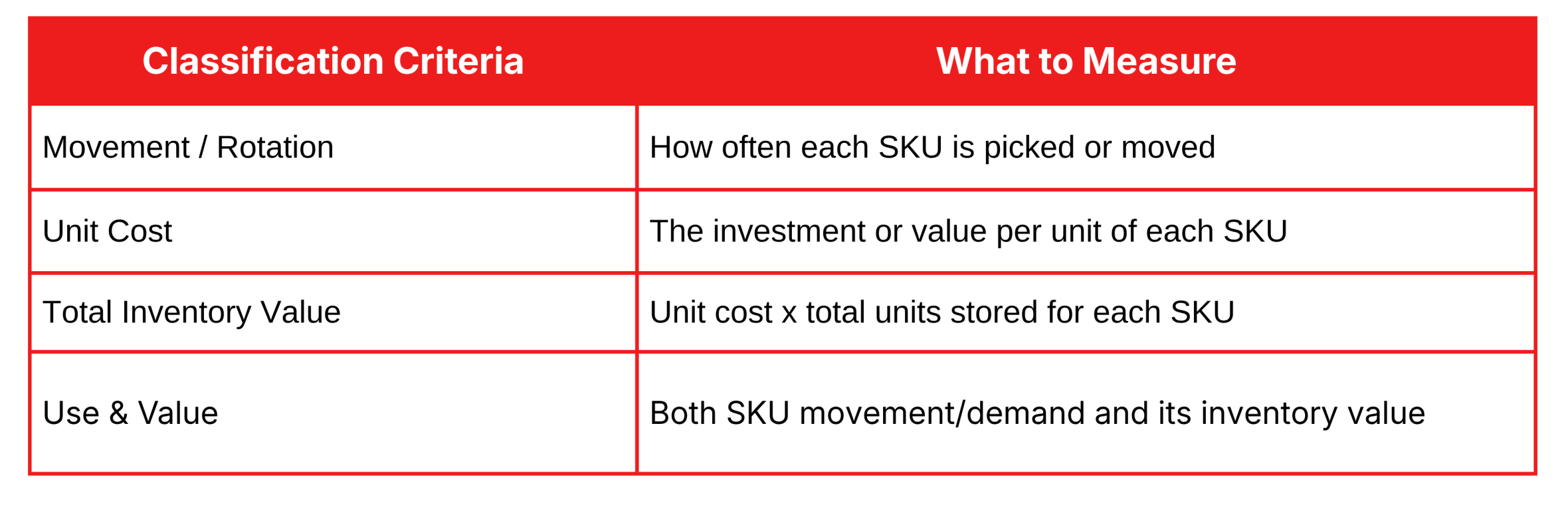
Category A (Highest Priority)
Category A includes SKUs with the highest importance based on the selected criteria.
They require greater operational attention, such as closer inventory monitoring and, when classified by movement, more accessible storage locations to support frequent handling.
Category B (Medium Priority)
Category B includes SKUs with moderate importance between A and C.
They generally require a balanced level of inventory control and accessibility. Because their demand or value may change over time, B items should also be reviewed periodically to determine whether their classification has changed.
Category C (Lower Priority)
Category C includes SKUs with lower importance based on the selected criteria.
When classified by movement, these products typically require less frequent access and can be allocated to less accessible storage locations, allowing prime warehouse space and resources to be prioritized for higher-activity inventory.
How ABC Analysis Supports Warehouse Slotting
Once SKUs have been classified based on their movement, the results can help determine where inventory should be positioned within the warehouse.
The general principle is simple: the more frequently an item is accessed, the easier it should be to reach.
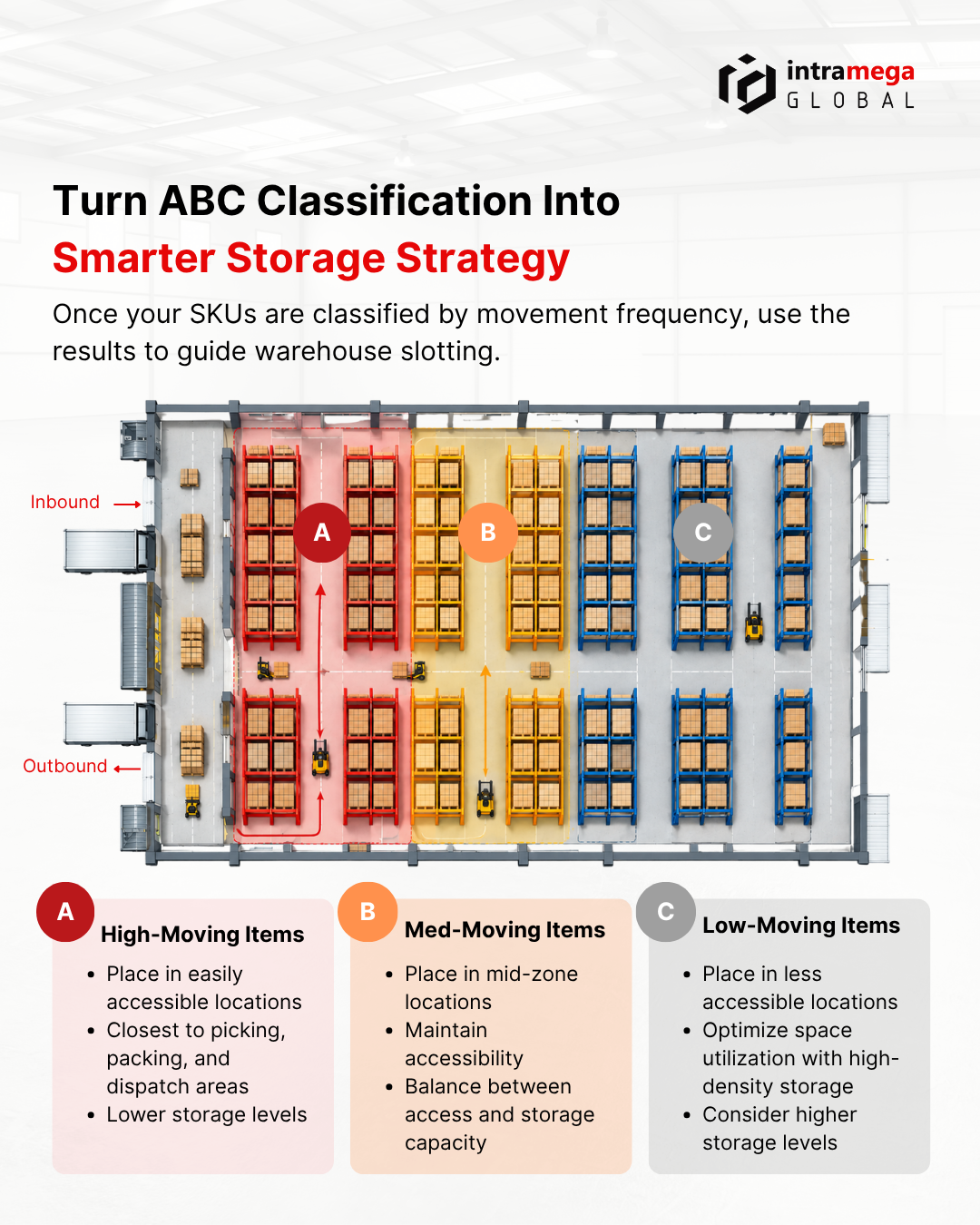
Category A: High-Moving Items
A items are accessed most frequently, so the objective is to minimize the time and effort required for picking and replenishment.
Even a small reduction in travel distance per pick can become significant when multiplied across high-frequency SKUs and thousands of warehouse transactions.
For A items, consider:
- Place in easily accessible locations
- Position closest to picking, packing, and dispatch areas
- Prioritize lower and more ergonomic storage levels
Category B: Medium-moving Items
B items require regular access, but they do not necessarily need to occupy the warehouse’s most valuable picking locations.
The objective is to balance accessibility with storage capacity, while reserving prime locations for higher-moving A items.
For B items, consider:
- Place in secondary or mid-zone locations
- Maintain reasonable accessibility
- Balance accessibility and storage capacity
B items should also be reviewed periodically, as changes in demand may cause them to move into either Category A or C.
Category C: Slow-moving Items
Because C items are accessed less frequently, the objective is to use warehouse space efficiently without unnecessarily occupying prime operational locations.
For C items, consider:
- Place in less accessible locations
- Consider higher storage levels where appropriate
- Optimize space utilization with high-density storage
Pro tip from our consultant!
ABC classification should guide your slotting strategy.
But product dimensions, weight, order profile, replenishment frequency, material handling equipment, safety, and storage constraints should also be considered before relocating inventory.
ABC Analysis to Improve Cycle Counting
ABC Analysis can also help warehouses improve cycle counting strategy, because it classifies inventory based on its priority and operational importance. Therefore, the cycle counting can be performed from the most important
The approach could be like this:
- Category A: Count most frequently, such as weekly or monthly.
- Category B: Count at a moderate frequency, such as quarterly.
- Category C: Count less frequently, such as annually
Pro tip from our consultant!
Your actual cycle counting schedule should also consider factors such as inventory accuracy, product value, criticality, transaction frequency, and operational risk.
Prioritizing what to count and how often is one part of the strategy. The next question is how efficiently the counting itself can be performed.
For warehouses managing high SKU volumes or frequent cycle counts, technologies such as RFID can help reduce manual scanning by allowing multiple tagged items to be identified more efficiently.
Common Mistakes When Applying ABC Analysis
Here are some common mistakes to avoid:
#1 Using Revenue as the Only Criterion
One common mistake is classifying inventory based solely on its monetary value. While value is important, it may not reflect how inventory actually moves through the warehouse.
For example of misclassification:
- High-value but slow-moving item may be classified as Category A
- Lower-cost product but high-moving item may be classified as Category C.
If the classification is then used for warehouse slotting, the result may not support actual operational needs.
Best Practice:
Start with the objective of your ABC Analysis and use multi-criteria approach.
- Optimizing warehouse slotting: Use movement or rotation criteria
- Inventory investment / control: Use monetary value criteria
- Broader view: Use combination of criteria (movement, value, and demand)
#2 Neglecting Class B and C Items
Because Category A represents the highest-priority inventory, it naturally receives more attention. However, this doesn’t mean B and C items can be ignored.
Because poorly managed slow-moving inventory can also contribute to excess stock, obsolescence, and inefficient space utilization.
Best Practice:
Review B and C inventory periodically, monitor changes in demand, and assess whether slow-moving items are occupying more space than their operational importance justifies.
#3 Ignoring Product Characteristics
ABC classification tells you the priority of an SKU, but it doesn’t tell you everything about how that SKU should be stored.
Category A items may also be heavy, fragile, oversized, temperature sensitive, hazardous, or require specific handling equipment.
These physical and operational requirements can affect where and how it should be stored, regardless of its ABC category.
Best Practice:
Before changing storage locations, also consider product dimensions and weight, handling requirements, safety, storage conditions, material handling equipment, and replenishment needs.
#4 Not Updating ABC Classification Regularly
ABC classifications can change over time. An A item today may become B or C as demand changes, while a previously slow-moving SKU may become a high-priority item.
Seasonality, promotions, new product launches, changing customer demand, and product life cycles can all affect SKU movement and inventory priorities.
Best Practice: Review ABC classifications regularly (at least quarterly) and whenever there is a significant change in demand or inventory profile.
5 Steps to Apply ABC Analysis in Your Warehouse
ABC Analysis should not start by immediately labeling inventory as A, B, or C.
A more practical approach is to first understand what you want to improve, then use the classification to support the right warehouse decisions.
Here is a practical approach:
Step 1: Define What You Want to Improve
Start by identifying the warehouse problem you want to solve:
- Reduce picking travel
- Improve inventory accuracy
- Optimize storage utilization
- Prioritize cycle counting
- Improve inventory control
Your objective determines which ABC criteria should be used and how the results should be applied.
Step 2: Analyze Your Inventory Data
Once the objective is clear, collect the data needed to understand how your inventory behaves.
Depending on the analysis, this may include SKU movement history, order frequency, inventory quantities, unit value, total inventory value, demand, and stock levels.
The quality of your ABC classification depends heavily on the quality and relevance of the data behind it.
Step 3: Choose the Right Classification Criteria and Classify
Next, determine which criteria best support your objective.
For a broader view, you can combine multiple criteria to classify ABC items.
At this stage, you have your ABC classification, but don’t start relocating inventory yet.
Step 4: Map ABC Data Against Your Current Warehouse
Map your A, B, and C items against their existing storage locations and evaluate how well the current layout supports their movement.
For example, you may discover:
- High-moving A items located far from picking or dispatch
- Slow-moving C items occupying prime locations
- Frequently picked inventory stored at inefficient picking heights
- Storage locations that do not match product characteristics
Make sure to store it using the Product characteristics
At this stage, also consider product dimensions, weight, handling requirements, equipment, replenishment, safety, and existing storage systems before deciding what should be relocated.
Your current draft already points toward combining the ABC map with product characteristics.
Step 5: Implement, Review, and Adjust
Lastly, use the findings to develop improvement plans.
The recommendation might involve re-slotting inventory, adjusting storage zones, changing inventory control practices, improving storage utilization, or evaluating supporting warehouse technology.
After implementation, review whether the changes based on ABC classification have actually improved warehouse performance.
Reassess the ABC classification regularly and adjust the strategy accordingly.
Your Optimized Warehouse Can Start from ABC Analysis
ABC Analysis can be one of the starting points to optimize your warehouse performance.
It can help uncover opportunities to improve inventory placement, storage utilization, cycle counting, and overall inventory control.
Through our Warehouse Consulting Services, we can help you assess your current operations and develop practical recommendations based on your ABC analysis.
Let’s assess your warehouse!
Contact us: +62 811 9121 231