
Key Considerations When Choosing the Right Racking System
Key Considerations When Choosing the Right Racking System
Choosing the right warehouse racking system requires understanding 3 thins:
- How goods move
- How warehouse equipment operates
- How storage requirements affect daily operations
While different racking systems offer different advantages, not every solution is suitable for every warehouse.
A configuration that maximizes pallet positions may limit product accessibility, while a system designed for frequent picking may require more aisle space.
Therefore, selecting the right racking system should begin with a comprehensive evaluation of warehouse operations, rather than focusing solely on storage capacity.
Why Is Choosing the Right Racking System Important?
An efficient warehouse relies on a racking system that supports storage capacity, product accessibility, and smooth operational flow.
However, warehouses face different challenges depending on their storage needs, available space, and daily operations.
For example, a warehouse handling high volumes of fast-moving products may prioritize accessibility and efficient picking operations.
Meanwhile, a facility storing large quantities of similar products may benefit from a higher-density storage configuration.
These different operational requirements demonstrate why there is no one-size-fits-all racking solution.
The objective is to identify a storage system that balances three important aspects: storage capacity, operational efficiency, and product accessibility.
3 Key Factors to Consider When Choosing a Racking System
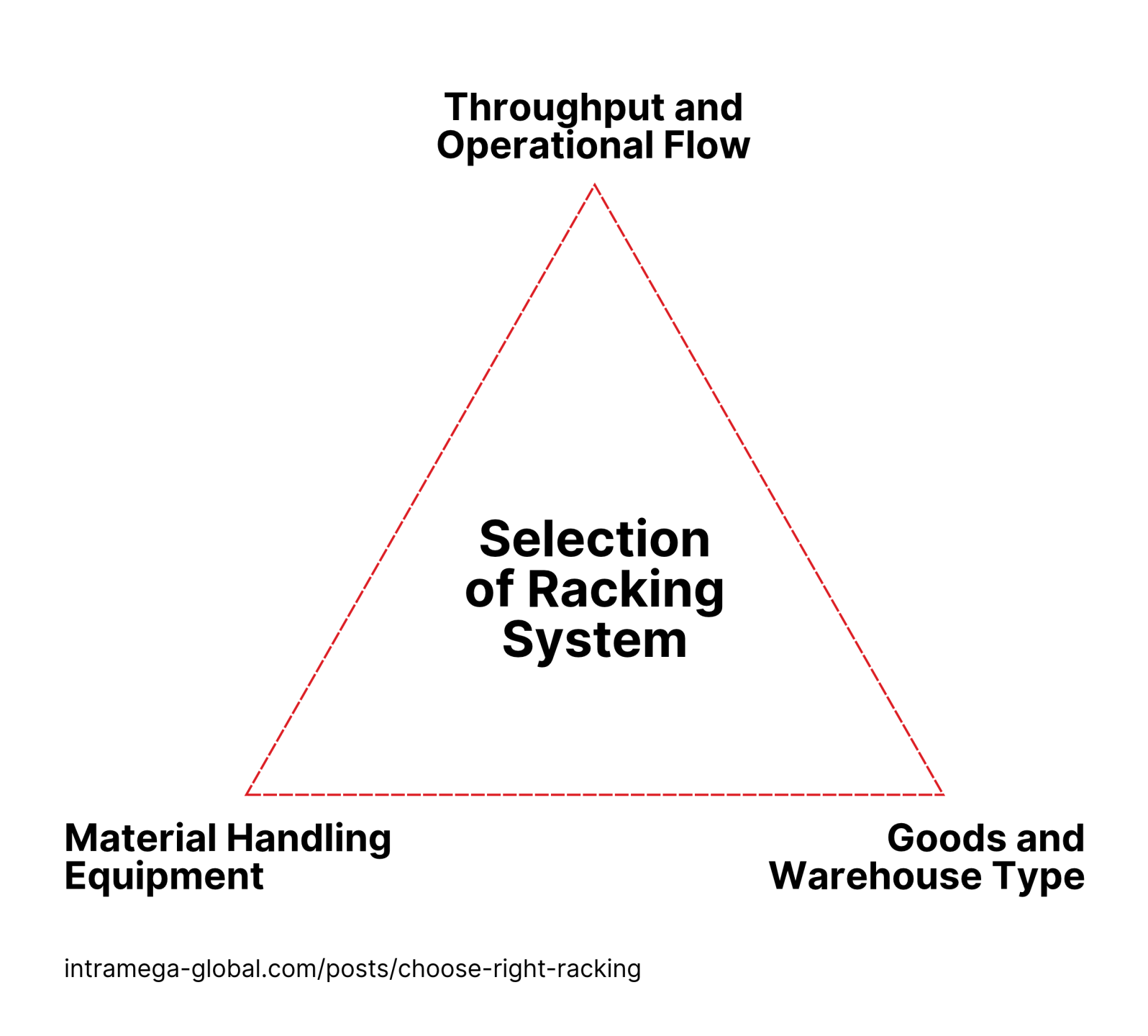
Before selecting a warehouse racking system, we always evaluate 3 key factors that directly influence storage configuration and operational performance.
Factor #1: Throughput and Operational Flow
Throughput and operational flow refer to the volume and movement of goods within a warehouse, from receiving, putaway, to dispatch.
Understanding these activities is essential because storage requirements are closely related to how frequently goods move through the warehouse.
Several operational factors should be evaluated:
- Inbound and outbound volume: The number of pallets, cartons, or orders handled daily influences storage accessibility and material handling requirements
- Picking and put-away frequency: Frequently accessed products may require storage locations that minimize travel distances and handling time
- Inventory rotation: FIFO (First-In, First-Out) or FEFO (First-Expired, First-Out) requirements may influence the suitability of different racking configurations
- SKU characteristics: The number of SKUs and quantity stored per SKU affect whether selective access or high-density storage is more appropriate
Consultant Tip! 
The key consideration is not simply how many pallets can be stored, but how efficiently those pallets can be accessed and moved.
Factor #2: Material Handling Equipment
The type of material handling equipment used in a warehouse has a significant influence on racking system selection and layout design.
Forklifts, reach trucks, and other handling equipment have different operating requirements, including aisle width, turning radius, lifting height, and load capacity.
These specifications determine how racking systems should be configured to ensure safe and efficient material movement.
Important considerations include:
- Aisle width requirements: Sufficient operating clearance is necessary for equipment to maneuver and retrieve loads safely
- Maximum lifting height: The equipment must be capable of accessing the required storage levels at the specified load weight
- Load dimensions and capacity: Pallet dimensions, load weight, and equipment capacity influence storage level design and handling compatibility
- Equipment maneuverability: Turning requirements and operating patterns affect aisle configuration and warehouse traffic flow
Racking design and material handling equipment should be evaluated together, rather than treated as separate decisions.
This approach helps to avoid layouts that provide sufficient storage capacity but create limitations during daily operations.
Factor #3: Goods and Warehouse Type
The characteristics of stored goods and the physical conditions of the warehouse are equally important when determining a suitable racking system.
Different products require different storage configurations based on their dimensions, weight, packaging, handling requirements, and storage environment.
Key considerations include:
- Product dimensions and weight: Load characteristics determine racking dimensions, beam capacity, and structural requirements
- Storage unit type: Palletized goods, cartons, long materials, and small parts may require different storage systems
- Warehouse dimensions: Building height, column positions, floor conditions, and available space influence the feasible racking layout
- Storage environment: Ambient warehouses, cold storage facilities, and specialized storage areas may have different material and operational requirements
- Future storage needs: Changes in inventory volume, SKU variety, or product characteristics should be considered when planning storage capacity
Warehouse conditions also influence design decisions.
Cold storage facilities, for instance, may prioritize higher storage density to make efficient use of temperature-controlled space, while maintaining appropriate product accessibility and operational flow.
Ultimately, the most suitable racking system depends on both the characteristics of the goods and the environment in which they are stored.
How Intramega Global Approaches the Right Racking Solution
Step #1: Identify Warehouse Requirements
We identify the warehouse’s existing conditions, operational activities, and storage objectives.
This includes reviewing warehouse dimensions, inventory characteristics, material handling equipment, and the movement of goods throughout the facility.
Understanding these factors helps identify operational challenges, such as insufficient storage capacity, inefficient picking routes, limited accessibility, or underutilized warehouse space.
The objective is to establish a clear understanding of what the warehouse needs to achieve before determining the most appropriate storage configuration.
Step #2: Evaluate Suitable Racking Configurations
This involves assessing the trade-offs between storage density, product accessibility, operational efficiency, and equipment compatibility.
By comparing these considerations, you can make more informed decisions about which storage approach best supports your operations.
Step #3: Develop the Right Racking Solutions
This step includes determining suitable racking dimensions, storage levels, aisle configurations, and equipment clearances while considering load requirements and applicable safety standards.
The proposed configuration should also account for future operational changes, such as increased inventory volume, additional SKUs, or evolving material handling requirements.
Through this approach, the racking system becomes part of a broader warehouse optimization strategy rather than simply a storage installation.
The Importance of Comprehensive Warehouse Planning
Comprehensive warehouse planning helps you ensure that your storage systems support both current operations and future requirements.
This includes aligning racking systems with material handling equipment and warehouse layouts, while considering safety, operational efficiency, and space utilization.
A well-planned warehouse provides a stronger foundation for adapting to changing storage needs and supporting long-term operational goals.
Choose a Racking System That Fits Your Warehouse Needs
Choosing the right racking system requires considering throughput and operational flow, material handling equipment, and goods and warehouse type.
Evaluating these factors together helps you identify suitable storage solutions based on your operational needs.
We offer a range of warehouse infrastructure solutions to address different storage and facility requirements.
By understanding their specific needs, you can explore suitable options to support your warehouse operations.
You can contact our team to discuss more about your operation needs: +62 811 9121 231