
Drive-in pallet racking is a high-density storage system designed to store large quantities of homogeneous products using a First-In, Last-Out (FILO) inventory principle.
By allowing forklifts to drive directly into storage lanes, the system eliminates multiple aisles and maximizes space utilization. Drive-in pallet racking is ideal for operations where storage density is a priority and SKU variety is limited.
Why Drive-In Pallet Racking is Suitable for You
01
Maximum Storage Density
By eliminating aisles between racks, you can significantly increase pallet capacity within the same warehouse footprint.
02
Ideal for Large Volumes of Similar Goods
The system is best suited for operations with low SKU variety and high pallet quantities per SKU.
03
Simple and Cost-Effective Design
Drive-in racking offers a straightforward structure with lower investment compared to automated high-density systems.
04
Well-Suited for FILO Inventory Flow
The FILO logic works effectively for products with stable demand patterns or non-time-sensitive inventory.
How Does Drive-In Pallet Racking Work?
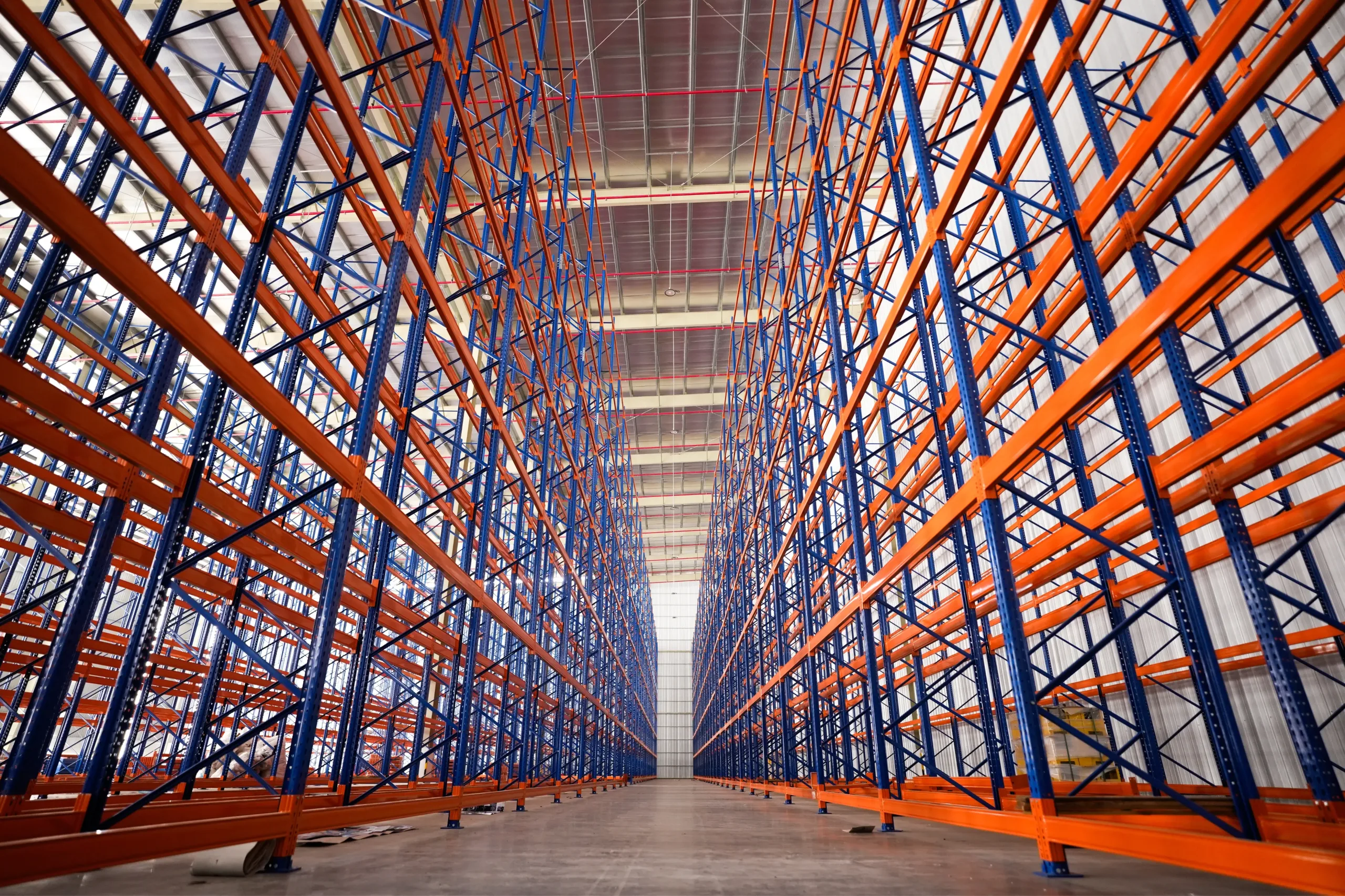
Drive-in pallet racking consists of deep storage lanes where forklifts enter the racking structure to place and retrieve pallets.
Pallets are stored on continuous support rails rather than beams, allowing forklifts to drive into the lane and position pallets at multiple depths. The number of pallets stored per lane depends on lane depth, pallet size, load weight, and available building height.
Since pallets are loaded and retrieved from the same side, the system follows a First-In, Last-Out (FILO) inventory method.
This configuration delivers very high storage density while maintaining a relatively simple operational setup.
System Structure
Drive-in pallet racking systems are built with reinforced components designed to withstand forklift entry and impact, including:
- Frames – heavy-duty uprights supporting the racking structure
- Pallet support rails – continuous rails that hold pallets within each lane
- Top bracing and frame ties – providing overall system stability
Optional safety and protection features include:
- Upright and rail protectors
- Guide rails to assist forklift entry
- Pallet backstops
- Impact protection at lane entrances
- Load signage and safety labels
These features help improve operational safety and extend system lifespan.
Explore Our Case Studies
See some selected examples of Drive-In Pallet Racking projects implemented across customer sites.


Other Storage Systems


Talk to Our Experts
Let’s discuss how we can help streamline your warehouse operations and reduce inefficiencies.