
RFID in Warehouse Management: How It Works & Implementation Guide (2026)
RFID in Warehouse Management: How It Works & Implementation Guide (2026)
RFID can help your warehouse identify inventory without scanning every barcode individually.
But that does not mean you can simply attach RFID tags to your products and expect everything to be tracked automatically.
A working RFID warehouse system requires you to make five practical decisions:
- What do you need to track?
- Where should the RFID tag be attached?
- Where should the tag be read?
- What warehouse activity should the reading trigger?
- Which system should receive the data?
In this practical guide, you will learn how RFID works, which equipment you need, where it can be used, and how to evaluate whether it is suitable for your warehouse or not.
What Is RFID in Warehouse Operations?
RFID stands for Radio Frequency Identification. It is a wireless technology that uses radio waves to identify tagged items and capture their data.
In a warehouse, an RFID tag can be attached to:
- An individual item
- A carton
- A tote bin
- A pallet
- A returnable container / Returnable Transport Items (RTI)
- A warehouse asset
Each tag contains a unique identification number. An RFID reader captures this number and sends it to the connected software, WMS, or ERP.
The system can then identify:
- What was detected
- Where it was detected
- When it was detected
- Which warehouse activities it belongs to
- Other information configured for the operation
The tag does not always store all this information itself. It may only carry a unique ID that the system uses to retrieve the relevant data from a database.
Which RFID Frequencies Are Used?
RFID systems operate across different frequency bands.
The three most common are:
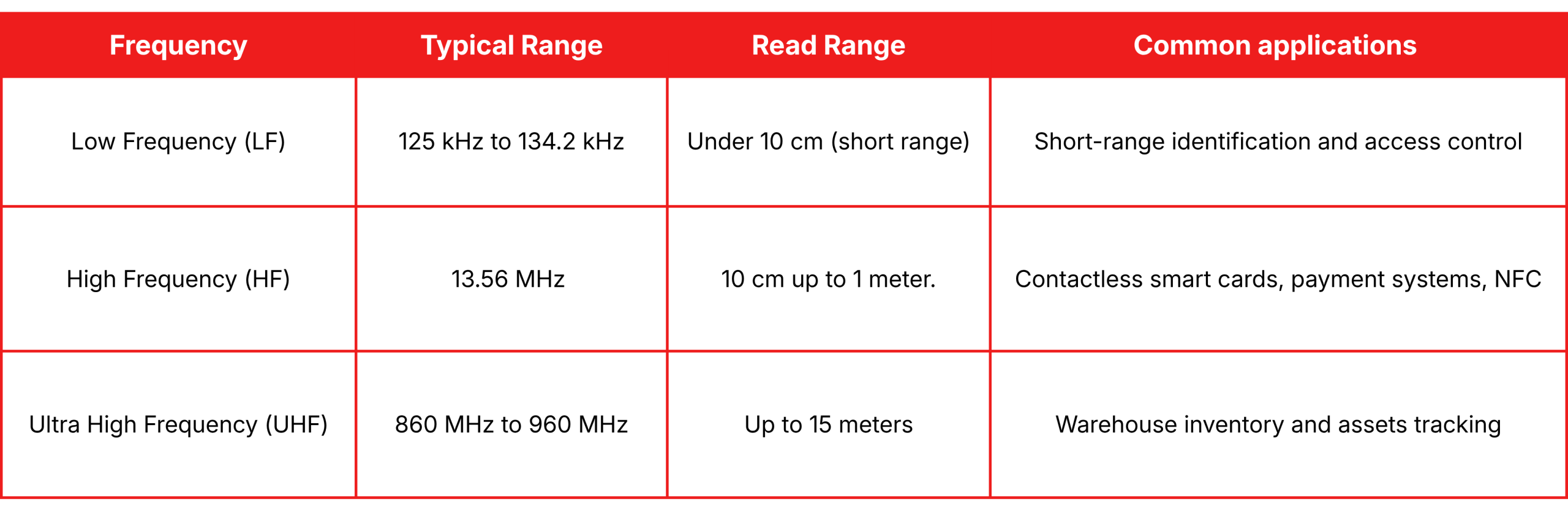
Each frequency offers different read ranges, data-transfer speeds, and performance characteristics.
For warehouse operations, UHF RFID is commonly used because it provides a longer reading range and can capture multiple tags quickly.
This makes it suitable for applications such as cycle counting, pallet tracking, receiving, and outbound verification.
However, the best frequency and tag type still depend on the material being tagged, warehouse environment, required reading distance, and process being automated.
What Are the Main Components of an RFID System?
A typical warehouse RFID system has 3 key hardware components:
#1 RFID Tag
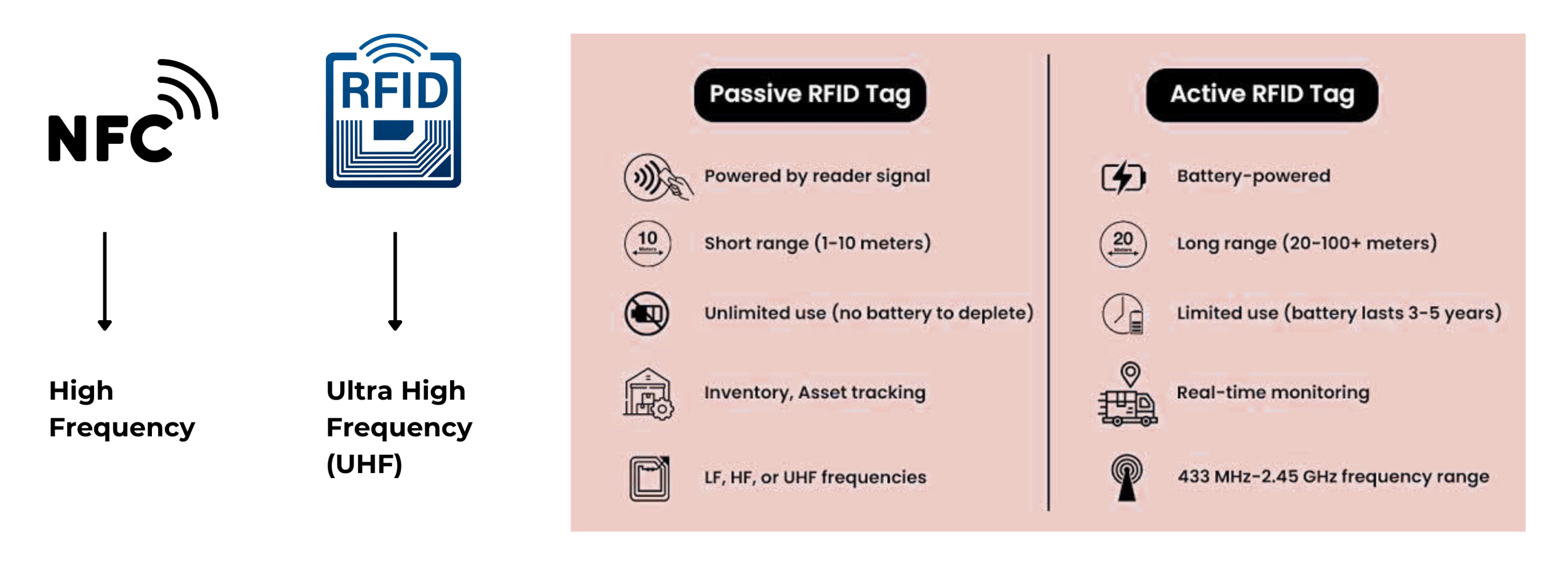
The RFID tag or transponder contains a chip and an antenna. It provides the unique identity of the item, carton, tote, pallet, or asset being tracked.
RFID tags can be:
- Passive: Powered by the reader’s radio signal
- Active: Powered by their own battery
- Battery-assisted passive: Uses a battery to support the tag but communicates when activated by a reader
Passive UHF tags are widely used in warehouse applications because they can be relatively small and economical, especially when many inventory units need to be tagged.
#2 RFID Reader
The RFID reader or interrogator communicates with the tag and captures its data.
Depending on the warehouse process, the reader may be:
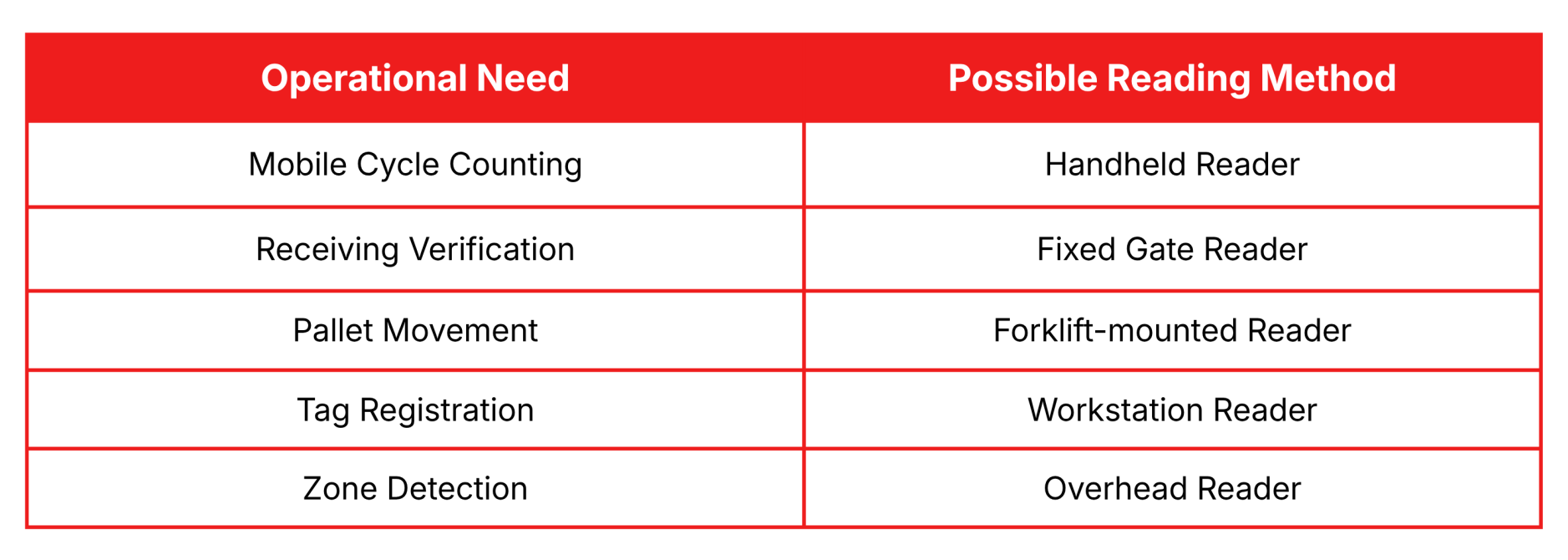
- Handheld reader: Carried by an operator for cycle counting, inventory searches, and exception handling
- Fixed gate reader: Installed at receiving, transfer, or outbound points
- Forklift-mounted reader: Used to identify pallets and verify inventory movements
- Overhead reader: Positioned above a defined area to detect movements within the reading zone
- Workstation reader: Used for tag registration and controlled processing activities
#3 RFID Antenna
The antenna transmits and receives radio signals between the reader and RFID tags.
Its position and direction help determine:
- Where tags can be detected
- How far the reading zone extends
- Which inventory movements should be captured
- How unwanted readings from nearby areas can be minimized
How Does RFID System Work?
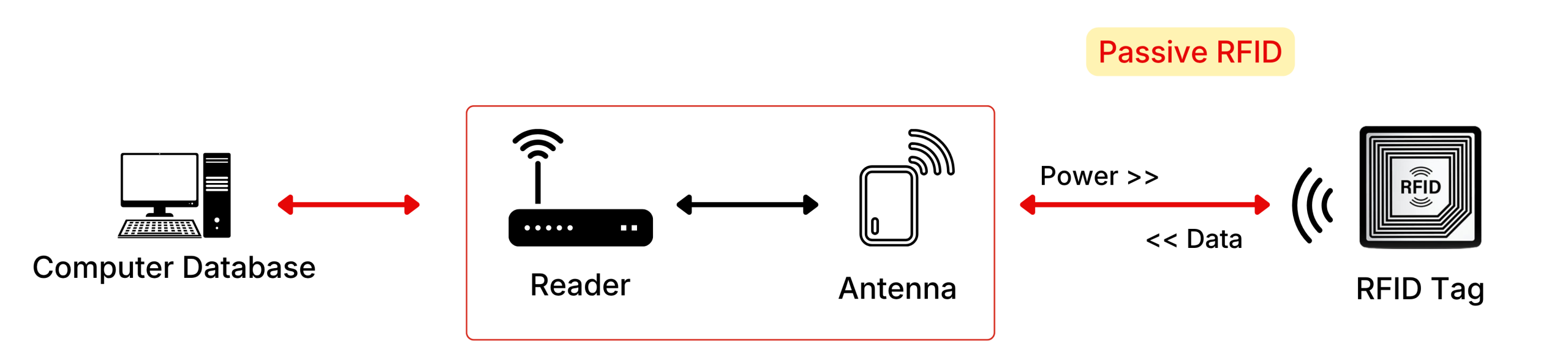
The process is as simple as this:
- The RFID reader sends a radio signal through its antenna.
- A compatible tag within the reading zone responds.
- The reader captures the tag’s unique identification.
- The RFID application filters and interprets the reading.
- The connected WMS or ERP processes the relevant warehouse activity.
RFID VS Barcode
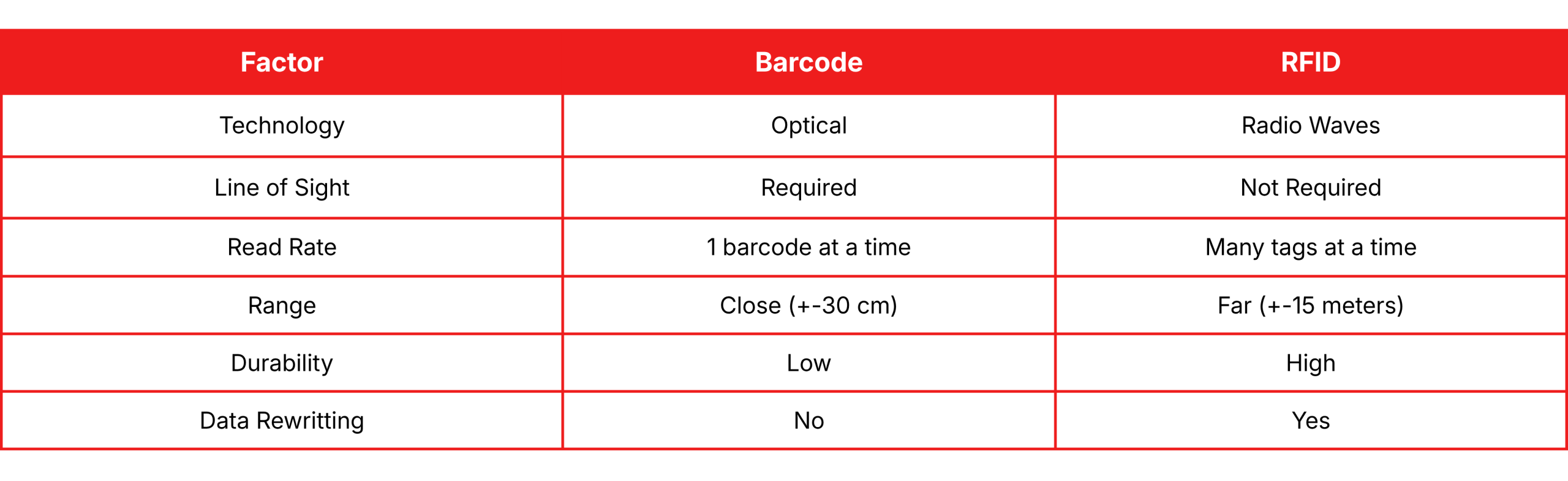
RFID and barcode serve a similar purpose: identifying physical objects and connecting them to digital information.
The main difference is how the data is captured.
With a barcode, an operator usually needs to locate the label, point the scanner toward it, and scan it individually.
With RFID, the tag generally does not need to be directly visible. A suitable reader can also capture multiple tags within its reading zone.
RFID Use Cases in Warehouse Operations
#1 Automated Receiving
RFID can verify tagged items, cartons, totes, or pallets as they enter the warehouse.
For example, a fixed RFID reader can be installed at the receiving gate. When a pallet passes through, the system captures its tag and compares it with the expected purchase order, advance shipping notice, or transfer document.
The system can then:
- Confirm which pallets arrived
- Identify missing inventory
- Detect unexpected inventory
- Record the receiving time
- Alert the operator about a discrepancy
This reduces the need to scan every barcode individually, especially when goods arrive in high volumes.
#2 Putaway
RFID can help confirm that inventory is moved to the correct storage area or location.
This can be performed using:
- A handheld RFID reader
- A forklift-mounted reader
- Tagged storage locations
- Fixed readers covering controlled zones
For example, a forklift reader can detect both the pallet tag and the tag assigned to a rack location. The system then compares the actual destination with the putaway instruction.
If the pallet is placed in the wrong location, the operator can receive an alert before completing the task.
#3 Storage and Inventory Tracking
RFID can record inventory movements between designated warehouse areas and help workers find misplaced stock.
There are several ways to do this:
- Scan storage areas using a handheld reader
- Detect movements through fixed transition points
- Use forklift-mounted readers during pallet handling
- Install overhead readers for defined zones
However, the appropriate method depends on the level of location detail required.
#4 Cycle Counting
RFID can make cycle counting more efficient by reducing the need to locate and scan every barcode individually.
A typical RFID cycle-counting process works like this:
- The system provides the expected inventory for a location.
- A worker walks through the area with a handheld RFID reader.
- The reader captures tagged inventory within range.
- The system compares the detected tags with the expected records.
- Missing, unexpected, or misplaced inventory is reported.
- Authorized results are used to update the inventory record.
Handheld readers are commonly used because workers can move between aisles and adjust the reading distance as needed.
Fixed, forklift-mounted, or overhead readers may also support inventory counting, but they require a more carefully controlled reading environment.
#5 Picking and Packing
RFID can verify whether the correct inventory has been selected for an order.
During picking, a handheld reader can help an operator:
- Confirm the correct item or pallet
- Search for inventory
- Detect a wrong selection
- Verify multiple tagged units
At a packing workstation, RFID can compare the detected items with the order requirement before the carton is closed.
#6 Outbound/Shipment Verification
RFID can provide a final verification point before goods leave the warehouse.
A fixed RFID reader installed at the dispatch door can capture tagged cartons or pallets as they move into the loading area. The system then compares the detected inventory with the delivery order or shipment requirement.
It can identify:
- Correct inventory
- Missing cartons or pallets
- Additional inventory
- Inventory assigned to another shipment
- Untagged inventory
This helps the warehouse detect loading errors before the truck departs.
For example, a delivery order requires:
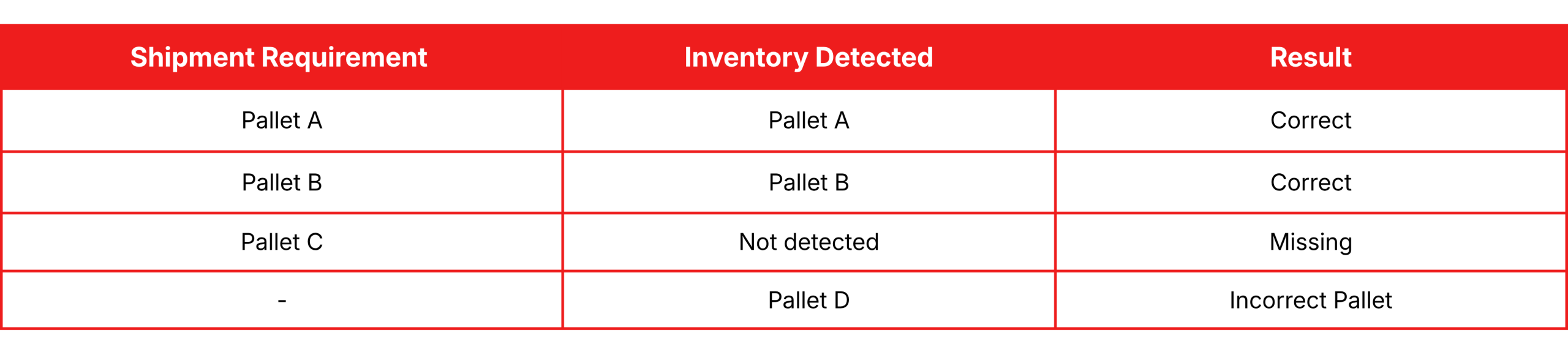
The system alerts the operator so Pallet D can be removed and Pallet C can be located before the truck departs.
#7 Returnable Asset Tracking
RFID can also track reusable assets that move repeatedly between warehouses, stores, suppliers, customers, or production facilities.
These assets may include:
- Tote bins
- Pallets
- Containers
- Roll cages
- Tools
- Material-handling equipment
- Other returnable transport items
Each asset receives a unique RFID identity. The system records when it is dispatched, received, transferred, or returned.
This can help answer practical questions such as:
- How many totes were sent to each location?
- Which pallets have not been returned?
- How long has an asset remained outside the warehouse?
- Which customer or branch last received it?
- How many reusable assets are currently available?
Benefits of RFID in Warehouse Operations
Here are the main operational benefits of using RFID in warehouse:
#1 Faster Cycle Count
RFID can capture multiple suitable tags without requiring workers to locate and scan every barcode individually.
This can significantly reduce the time required for cycle counting or stock opname, up to 92%.
However, the actual improvement will depend on the number of tags, product materials, storage density, reader type, and current counting process.
#2 Higher Inventory Accuracy
Manual counts can be affected by missed scans, duplicate entries, incorrect item identification, and delayed system updates.
RFID can reduce these risks by capturing unique tag identities and comparing physical inventory with system records.
RFID can improve data capture, but accurate master data and reliable tag registration are still required.
#3 Better Inventory and Asset Visibility
Each valid RFID reading can create a record containing:
- Tag identity
- Detection time
- Reading point
- Inventory or asset status
- Related warehouse activity
This provides a more traceable movement of history for inventory and reusable assets.
#4 More Reliable Receiving and Dispatch
Fixed readers can automatically compare incoming or outgoing inventory with the expected document.
This helps warehouses verify:
- What physically arrived
- What was loaded
- What is missing
- What does not belong to the transaction
#5 Better Control of Returnable Assets
RFID allows reusable pallets, bins, containers, and tools to be identified individually rather than managed only as a total quantity.
The warehouse can monitor:
- Asset dispatch and return
- Last known location
- Time outside the warehouse
- Number of usage cycles
- Inspection and maintenance history
- Missing or overdue assets
This can reduce unnecessary replacement purchases and help the company use its existing asset pool more effectively.
Limitations of RFID in a Warehouse
#1 Metal and Liquid Can Affect Performance
Metal can reflect radio waves, while liquids can absorb them. Both may reduce read performance when standard RFID tags are used incorrectly.
This does not necessarily prevent RFID from being used. It may require:
- Anti-metal tags
- Different tag placement
- Specialized tag designs
- Adjusted antenna positions
- Testing with the actual product
#2 Tag Placement Must Be Tested
The same RFID tag may perform differently depending on where and how it is attached.
A tag placed on the outside of a carton may read well, while the same tag positioned close to metal or liquid inside the carton may not.
That is why we validate every RFID solution through a controlled Proof of Concept (PoC) using your actual products, packaging, pallet arrangements, and operating conditions. This allows us to confirm read performance, process compatibility, and system integration before full deployment.
#3 RFID Still Requires Reliable Data
RFID can capture a tag accurately, but it cannot correct an incorrect connection between the tag and the inventory record.
If a tag is registered to the wrong item, batch, pallet, or quantity, the system will process incorrect information more quickly.
That is why reliable master data and tag registration procedures remain essential.
#4 RFID Cannot Fix a Poorly Designed Process
Adding RFID to an unclear or inconsistent warehouse process may only automate the existing problem.
Before implementation, the warehouse should define its process, responsibilities, exception handling, and expected system transactions.
If you are still not sure whether your warehouse is ready to implement RFID or not, our Consulting Services can help assess your current operations, identify the hidden inefficiencies, and develop a practical improvement roadmap.
How to Implement RFID in a Warehouse
Step 1: Identify the Warehouse Problem
Define the operational issue RFID is expected to solve.
For example:
- Cycle counting takes several days.
- Pallets are loaded onto the wrong trucks.
- Tote bins regularly go missing.
- Receiving requires too much manual scanning.
- Inventory movements are difficult to trace.
Pro Tip!
Make the problem measurable by documenting its frequency, time, labor requirement, or operational impact.
Step 2: Map the Current Process
Document how your warehouse activity currently works from beginning to end:
- Who performs each task
- Where inventory moves
- Which labels are scanned
- Which systems are updated
- Where delays or errors occur
- How exceptions are handled
This helps determine where RFID data should be captured.
Step 3: Select the Tagging Level
Decide whether RFID should identify the:
- Item
- Carton
- Tote
- Pallet
- Returnable asset
Choose the tagging level based on the warehouse activity you want to improve.
You do not need to tag everything from the beginning.
Start with the process or inventory level that consumes the most time and effort, creates frequent errors, or causes the greatest operational inefficiency.
Step 4: Test Tags on Actual Inventory
Test several suitable tags using the warehouse’s real products and packaging.
Evaluate:
- Read distance
- Tag orientation
- Product material
- Carton contents
- Pallet configuration
- Environmental conditions
- Tag durability
Step 5: Select the Reading Method
Choose how and where tags should be captured. A process may use more than one reader type.
Step 6: Design the Reading Zone
Define exactly where tags should and should not be detected.
A properly designed reading zone helps the system capture the correct tags at the correct point in the warehouse process.
Key aspects to test include:
- Antenna position and angle
- Reader power
- Reading distance
- Movement direction
- Nearby tagged inventory
- Simultaneous movements
- Physical protection for the equipment
Step 7: Define the Expected System Transactions
For every valid RFID event, determine what the system should do.
For example:
Pallet detected at outbound gate → compare with delivery order → approve movement or generate an alert.
Also define what should happen when:
- A required tag is missing
- An unexpected tag is detected
- The same tag is read repeatedly
- A tag is damaged
- The network is unavailable
- Inventory passes through the wrong gate
Step 8: Integrate RFID With Existing Systems
Connect the RFID data to the WMS, ERP, or other application responsible for processing the warehouse activity.
The integration should define:
- Required data fields
- Transaction triggers
- Validation rules
- Duplicate-read filtering
- Error messages
- User notifications
- Audit records
Step 9: Run a Proof of Concept
Test the complete process in a controlled area.
The proof of concept should include normal operations as well as difficult scenarios, such as:
- Mixed products
- Dense pallet arrangements
- Metal or liquid products
- Fast-moving inventory
- Multiple pallets passing together
- Incorrect or missing inventory
- Tags positioned in different orientations
Once the agreed performance criteria have been achieved, the RFID solution can proceed to full-scale implementation.
Frequently Asked Questions About Warehouse RFID
#1 Can RFID Track the Exact Location of Inventory?
It depends on the system design.
RFID can confirm that inventory passed through a gate, was detected in a zone, or was found near a specific location. Precise, continuous location tracking requires additional reader infrastructure and a more specialized design.
RFID does not automatically provide GPS-like positioning.
#2 How Many RFID Tags Can Be Read at Once?
RFID readers can capture multiple tags during one reading session, but there is no universal number.
Actual performance depends on:
- Tag type
- Reader and antenna configuration
- Number and density of tags
- Product materials
- Tag orientation
- Reading distance
- Movement speed
- Environmental interference
The required quantity should be validated during testing.
#3 Can RFID Work Together With Barcode?
Yes. RFID and barcode can be used within the same warehouse.
For example, RFID may be used for pallet tracking and outbound verification, while barcodes remain in use for individual products. This hybrid approach can provide automation where it creates value without replacing the entire identification system.
#4 Can RFID Integrate With an Existing WMS?
Yes, provided that the WMS supports the required transactions or can exchange data with an RFID application.
RFID typically captures the physical event, while the WMS validates and processes the corresponding warehouse transaction.
#5 Is RFID Suitable for Metal Products?
Yes, but standard RFID labels may perform poorly when attached directly to metal.
On-metal tags, appropriate placement, and reader configuration may be required. Performance should be tested on the actual product.
#6 How Much Does a Warehouse RFID System Cost?
The cost depends on:
- Number and type of tags
- Handheld or fixed readers
- Antennas and supporting infrastructure
- Software requirements
- WMS or ERP integration
- Installation and testing
- Training and ongoing support
Ready to Explore RFID for Your Warehouse?
Every RFID project should start with the right operational problem, not the hardware.
Intramega Global can help assess your warehouse processes, identify suitable RFID use cases, validate the solution through a controlled Proof of Concept, and integrate it with your existing WMS or ERP.
Whether you want to improve cycle counting, automate receiving, verify outbound shipments, or track pallets and returnable assets, our team can help determine the right approach for your operation.
Contact us to discuss your requirements: +62 811 9121 231