
RFID Tagging Levels: Which Warehouse Items Should You Tag?
RFID Tagging Levels: Which Warehouse Items Should You Tag?
RFID can improve inventory visibility and automate identification across warehouse operations. However, implementing RFID does not necessarily mean attaching a tag to every individual product.
RFID can be applied at different tagging levels, depending on what needs to be identified and tracked.
It can be tagged into:
- Individual items
- Cartons
- Tote bins / containers
- Pallets
- Returnable transport items (RTI)
- Warehouse assets
Therefore, choosing the right tagging level is an important part of RFID implementation.
Because it will determine 3 things:
- What the system can identify
- How much visibility you can achieve
- Where RFID can support your warehouse processes
In this guide, we break down the 6 common RFID tagging levels used in warehouse operations, where each one is typically applied, and how to determine which approach fits your operation.
💡 New to RFID? Read our complete guide RFID in Warehouse Management: How It Works & Implementation Guide (2026) to understand how RFID works, its components, warehouse use cases, benefits, limitations, and implementation process
What Is an RFID Tagging Level?
An RFID tagging level defines the unit that each RFID tag is used to identify and track within an operation.
Depending on the level of visibility required, one RFID tag may represent an individual product, a carton, a tote, a pallet, a returnable container, or a warehouse asset.
For example:
- Item-level: 1 RFID tag identifies 1 individual item
- Carton-level: 1 RFID tag identifies 1 carton, which may contain multiple items
- Pallet-level: 1 RFID tag identifies 1 pallet, which may carry multiple cartons
The more granular the tagging level, the more detailed the identification can be.
However, more detail does not always mean better.
For example, if inventory is received, stored, and shipped primarily by pallet, tagging every individual item may add unnecessary cost and complexity without providing meaningful operational value.
Why Does the RFID Tagging Level Matter?
The tagging level determines more than just where an RFID tag is attached.
It influences the overall RFID system design, including:
- What needs to be identified: from individual products to reusable assets
- Where visibility is required: such as receiving, storage, picking, shipping, or movement between locations
- How many RFID tags are needed: item-level tagging can require significantly more tags than pallet-level tagging
- How RFID will be read: using handheld readers, fixed readers, RFID portals, or forklift-mounted readers
- How RFID data connects with your system: including relationships between items, cartons, totes, pallets, and transactions in the WMS or ERP
That’s why, the right RFID tagging level starts with understanding what you need to track and where you need visibility.
Types of RFID Tagging Levels in Warehouses
In a warehouse, the common RFID tagging levels are:
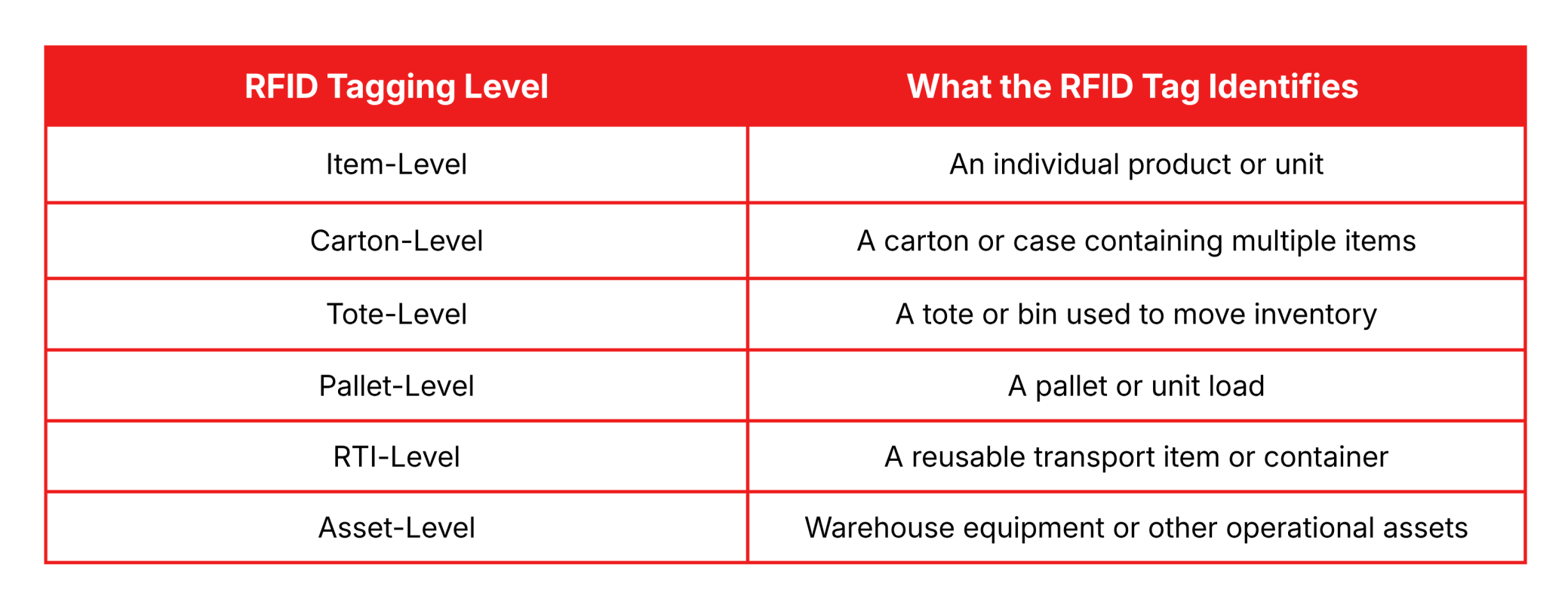
This distinction becomes especially important when designing an RFID system, as each tagging level provides a different degree of visibility.
Let’s discuss them one by one.
#1 Item-Level RFID
With item-level tagging, each individual product or inventory unit receives its own unique RFID tag.
This allows the RFID system to identify individual units rather than only the carton, tote, or pallet carrying them.
When Does Item-Level RFID Needed?
Item-level RFID is most useful when warehouse operations require visibility or verification at the individual-unit level, such as when:
- Products are picked and shipped individually
- Individual units need to be counted during cycle counts
- Serial-level or unit-level traceability is required
- Inventory frequently moves independently from its original carton or pallet
- High-value products require tighter inventory control
How Is Item-Level RFID Used in Warehouse Operations?
One of the most practical applications is cycle counting.
With barcode-based counting, operators typically need to locate and scan products individually.
With RFID, a handheld reader can detect multiple RFID-tagged items within its reading area without requiring direct line-of-sight to each label.
Item-level RFID can also support other processes such as:
Receiving → Putaway → Cycle Counting → Picking → Packing → Shipping
However, item-level tagging also requires significantly more RFID tags than carton- or pallet-level identification.
Tag placement and readability must also be tested against the product and packaging materials.
That’s why, item-level RFID is most valuable when individual-unit visibility provides enough operational benefit to justify that additional level of identification.
#2 Carton-Level RFID
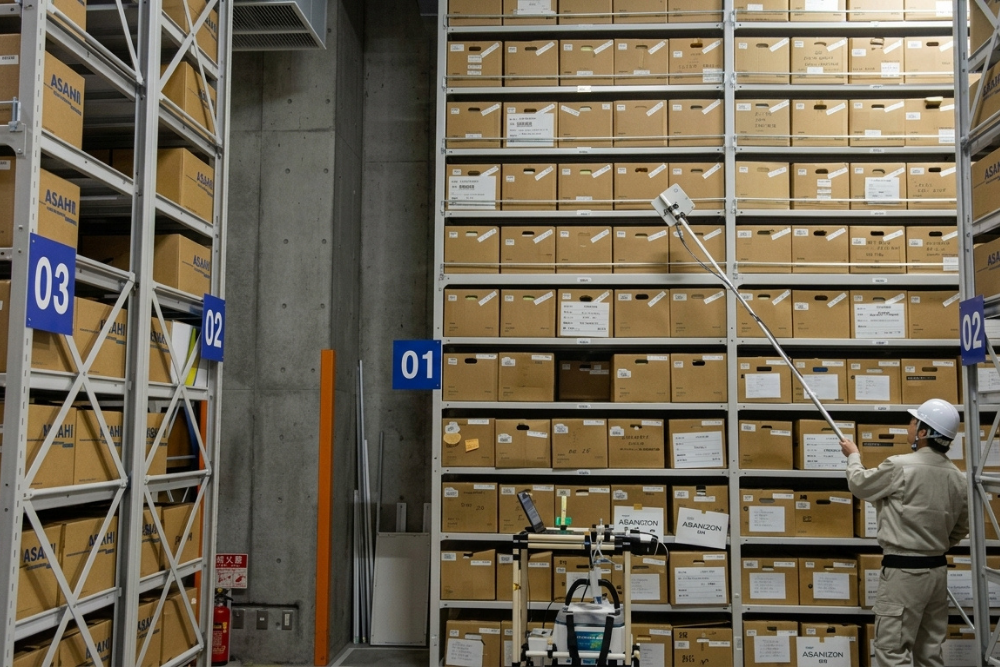
With carton-level RFID, each carton or case receives a unique RFID tag.
Instead of identifying every product individually, this system identifies the carton as one handling unit.
For example, if a pallet contains 20 cartons with 24 products in each carton, carton-level RFID would use 20 RFID tags rather than 480 item-level tags.
The contents of each carton can then be associated with its unique carton ID in the WMS or other inventory system.
This means RFID identifies which carton is moving, while the system knows what inventory should be inside that carton.
When Does Carton-Level RFID Needed?
Carton-level RFID is particularly useful when inventory is commonly received, stored, picked, or shipped in full cartons or cases, such as when:
- Products usually move as full cartons rather than individual pieces
- Multiple cartons need to be identified during receiving or shipping
- The operation needs more detailed visibility than pallet-level tracking
- Cartons are separated from their original pallets during storage or picking
- Individual item-level identification is not operationally necessary
How Is Carton-Level RFID Used in Warehouse Operations?
A common application is receiving and outbound verification.
For example, multiple RFID-tagged cartons can pass through an RFID gate during receiving.
The system captures the unique carton IDs and compares them against the expected shipment, reducing the need to scan each carton barcode individually.
Carton-level RFID can support processes such as:
Receiving → Putaway → Replenishment → Carton Picking → Staging → Shipping
However, carton-level RFID does not automatically verify every individual product inside the carton.
If products are removed, replaced, or mixed without the corresponding system update, the RFID tag will still identify the carton, not its actual contents.
That’s why, carton-level RFID works best when the contents of each carton remain consistent throughout the processes you want to track.
#3 Tote-Level RFID
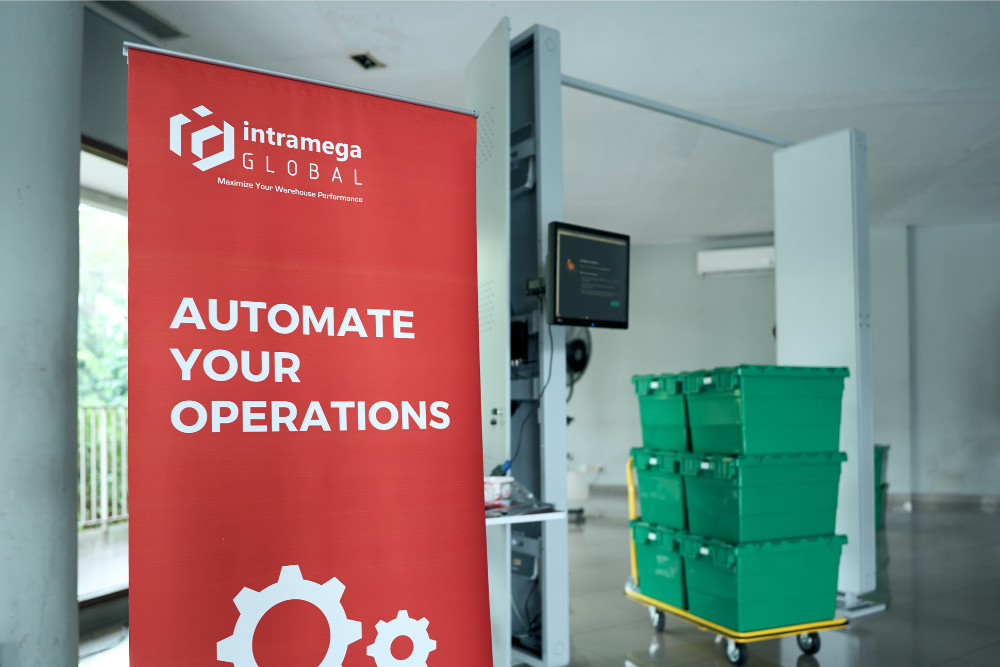
With tote-level RFID, each tote or bin receives a unique RFID tag.
This system identifies the tote as it moves through warehouse processes, while the products assigned to that tote are recorded and associated with its ID in the WMS or other warehouse system.
For example, during order picking, multiple items may be assigned to Tote 001.
Instead of tracking the movement of every product individually with RFID, the system can track Tote 001 as it moves from picking to consolidation or packing.
When Does Tote-Level RFID Needed?
Tote-level RFID is useful when totes or bins are consistently used as handling units for moving inventory between warehouse processes, such as when:
- Picked items are assigned to a specific tote
- Totes move between multiple workstations or process areas
- Orders need to be routed to the correct packing area
- Goods-to-person or automated storage systems use totes as handling units
- The operation needs visibility of work-in-progress inventory
How Is Tote-Level RFID Used in Warehouse Operations?
A common application is tracking inventory during picking and order fulfillment.
Once products are picked and assigned to a tote, the system creates an association between the inventory and the tote ID.
As the RFID-tagged tote passes predefined read points, such as RFID gate, its movement can be automatically captured without requiring operators to scan the tote barcode at every process.
A simplified process could look like:
Items Picked → Assigned to Tote → Tote Detected → Process/Location Updated → Consolidation or Packing
This can be really useful in operations where a large number of totes continuously move between picking, sortation, consolidation, and packing areas.
However, like carton-level, RFID detection of the tote does not automatically confirm the individual products inside it.
The accuracy of tote-level tracking therefore depends on maintaining the correct system association between the tote ID and its assigned contents.
That’s why, tote-level RFID works best when items are reliably assigned to and removed from each tote through controlled warehouse transactions.
#4 Pallet-Level RFID
With pallet-level RFID, each pallet receives a unique RFID tag so it can be identified as one handling unit throughout warehouse operations.
The inventory loaded onto the pallet can then be associated with the pallet ID in the WMS or other warehouse system.
For example, if a pallet carries 40 cartons, the warehouse can use one RFID tag to identify the pallet, rather than tagging all 40 cartons individually.
When Does Pallet-Level RFID Needed?
Pallet-level RFID is useful when inventory is received, moved, stored, and shipped as full pallets, such as when:
- Inbound goods arrive as full pallets
- Inventory remains on the same pallet during storage
- Forklifts perform most inventory movements
- Pallets need to be verified during receiving or shipping
- The operation needs visibility of pallet movements between warehouse areas
How Is Pallet-Level RFID Used in Warehouse Operations?
One common application is automated pallet identification at Inbound or outbound points.
For example, a forklift carrying an RFID-tagged pallet can pass through a RFID gate.
The system identifies the pallet and records the movement without requiring the operator to stop and manually scan a pallet barcode.
Pallet-level RFID can support processes such as:
Receiving → Putaway → Storage → Replenishment → Staging → Shipping
RFID readers can also be integrated with forklifts to identify pallets during movement, depending on the required process and RFID system design.
However, RFID detection of the pallet does not automatically confirm the cartons or individual products inside it.
If visibility of the pallet contents is also required, pallet-level RFID can be combined with carton- or item-level tagging.
#5 RTI-Level RFID
With RTI-level RFID, each Returnable Transport Item (RTI) receives a unique RFID tag so it can be identified and tracked as it circulates between warehouses, stores, suppliers, customers, or other locations.
RTIs can include reusable tote bins, plastic crates, pallets, roll cages, containers, and other reusable transport packaging.
Unlike carton- or pallet-level inventory tracking, the primary objective here is to track the returnable asset itself: where it is, where it has moved, and whether it has been returned.
When Does RTI-Level RFID Needed?
RTI-level RFID is useful when a business manages a large pool of reusable containers that regularly move between different locations, such as when:
- Returnable containers frequently leave the warehouse
- RTIs circulate between warehouses, stores, suppliers, or customers
- Missing or unreturned containers are difficult to identify
- The business needs better visibility of RTI circulation and return cycles
How Is RTI-Level RFID Used in Warehouse Operations?
RFID can create a unique identity for every RTI and automatically capture its movement at predefined read points.
For example, when RFID-tagged tote bins leave a distribution center for a retail store, their IDs can be captured during outbound.
When the empty totes return, RFID can identify them again during inbound.
This creates a movement history such as:
Issued → Outbound → Destination → Returned → Received → Available for Reuse
Over time, these records can help operations identify which RTIs are still outside the warehouse, where they were last recorded, how long they have been circulating, and which assets have not returned as expected.
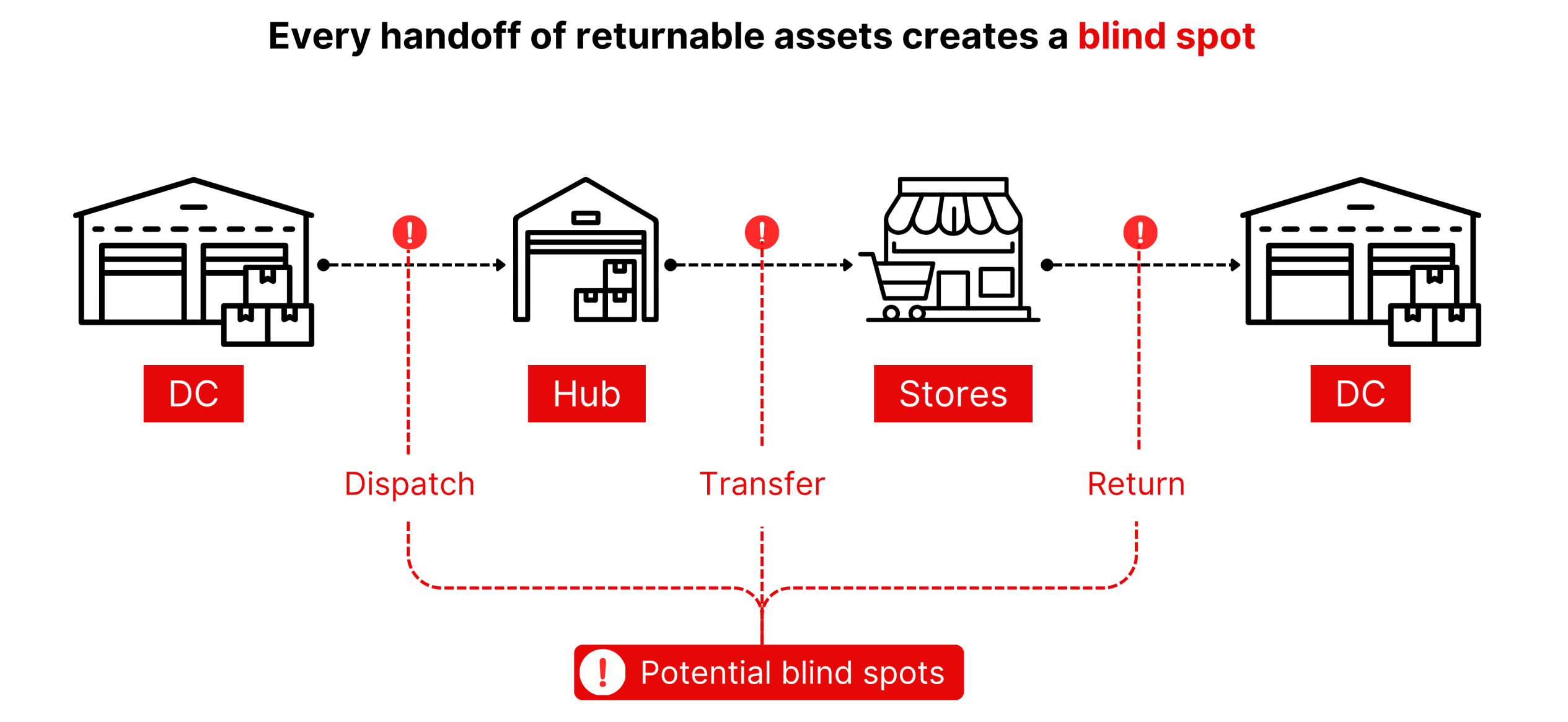
However, the RFID tag on an RTI identifies the returnable container itself, not automatically the products being transported inside it. If visibility of both is required, the RTI can be associated with its contents through the warehouse system or combined with carton- or item-level RFID.
The advantage of this approach is that the same RFID tag can remain attached to the RTI throughout multiple reuse cycles.
When the products inside the RTI change, the system can simply update which inventory is associated with that RTI ID without removing or replacing the RFID tag.
That’s why, RTI-level RFID works best when the objective is to maintain visibility and control over reusable transport assets throughout their circulation and return cycle.
#6 Asset-Level RFID
With asset-level RFID, each warehouse asset receives a unique RFID tag so its identity and movement can be tracked within the facility or across operational locations.
Unlike inventory, which represents the goods being stored or sold, warehouse assets are equipment and resources used to support warehouse operations.
These can include tools, material handling equipment, cages, movable devices, maintenance equipment, and other operational assets.
Of course, this is not limited to warehouse equipment.
But, also can be ussed to track assets across offices, manufacturing facilities, laboratories, hospitals, and other operational environments where better asset visibility is required.
When Does Asset-Level RFID Needed?
Asset-level RFID is useful when equipment frequently moves between locations and manual tracking makes it difficult to determine where an asset is or who last used it, such as when:
- Assets are shared between multiple warehouse areas or teams
- Equipment is frequently moved and difficult to locate
- Manual asset records are often outdated
- High-value equipment requires better movement traceability
- Operations need visibility into asset availability
How Is Asset-Level RFID Used in Warehouse Operations?
Each asset can be assigned a unique RFID identity and detected using handheld readers or at predefined RFID read points.
For example, if a tagged piece of equipment moves from a maintenance area into an operational zone, a fixed RFID reader can capture that movement and update its last detected location.
Warehouse staff can also use a handheld RFID reader to search for a specific tagged asset within an area.
A simplified asset movement history could look like:
Asset Registered → Assigned → Moved → Detected at Location → Returned → Available
This provides a more reliable movement record than relying solely on manual check-in/check-out or visual searches.
However, RFID does not provide continuous real-time location automatically. The level of location visibility depends on where and how RFID readers are deployed. A handheld reader may help locate an asset within a search area, while fixed readers can record when an asset passes specific checkpoints or zones.
That’s why, asset-level RFID works best when the objective is to improve visibility, traceability, and control of operational assets as they move between known locations or process points.
How to Choose the Right RFID Tagging Level for Your Warehouse
Now that you understand the different RFID tagging levels, the next question is: which one is right for your warehouse?
The answer is start by looking at how your warehouse operates, what you need to identify, and where better visibility would create the most value.
Here are 5 questions to consider:
#1 What Do You Need to Identify?
First, define exactly what you want the RFID system to track.
For example:
If your main problem is losing visibility of reusable containers after they leave the warehouse, then you need the RTI-level RFID.
On the other hand, if your problem is inventory discrepancies at the individual-level, then you need item-level RFID.
#2 Where Do You Need Visibility?
Next, identify where the visibility gap occurs.
This could be during:
Receiving → Putaway → Storage → Cycle Counting → Picking → Packing → Shipping → Returns
Or even outside the warehouse when returnable assets circulate between warehouses, stores, suppliers, and customers.
You do not necessarily need the same RFID visibility at every process point. Focus first on the processes where missing or delayed information creates the biggest operational problem.
#3 How Does Inventory Normally Move?
Does inventory normally move as:
- Individual pieces?
- Full cartons?
- Totes or bins?
- Full pallets?
If products remain on the same pallet from receiving through storage and shipping, pallet-level RFID may provide sufficient visibility.
However, if the pallet is broken down and cartons or individual items start moving independently, a more granular tagging level may be required for the processes that follow.
In general, the RFID tagging strategy should reflect how inventory actually moves, not just how it is initially received.
#4 How Much Identification Detail Do You Need?
Consider how much detail is necessary to solve the operational problem.
For example, is it enough for the system to know:
“Pallet 001 has arrived.”
Or does the operation need to confirm:
“Every individual unit expected on Pallet 001 has arrived.”
More detailed identification can provide greater traceability, but it also means more tags, more data, and potentially a more complex RFID implementation.
The objective is not to capture the most detailed data possible, but to capture the level of detail required to support the operation.
#5 Where andHow Will the RFID Tag Be Read?
Finally, consider where and how the RFID identification will happen.
Different processes may require different reading methods, such as:
- Handheld RFID readers for cycle counting or searching inventory
- Fixed RFID portals for automated receiving or shipping verification
- Forklift-mounted RFID readers for identifying pallet movements
- Fixed read points for monitoring specific movement or process zones
The tagging level, tag placement, reading distance, product material, and warehouse environment all influence whether RFID can be read reliably.
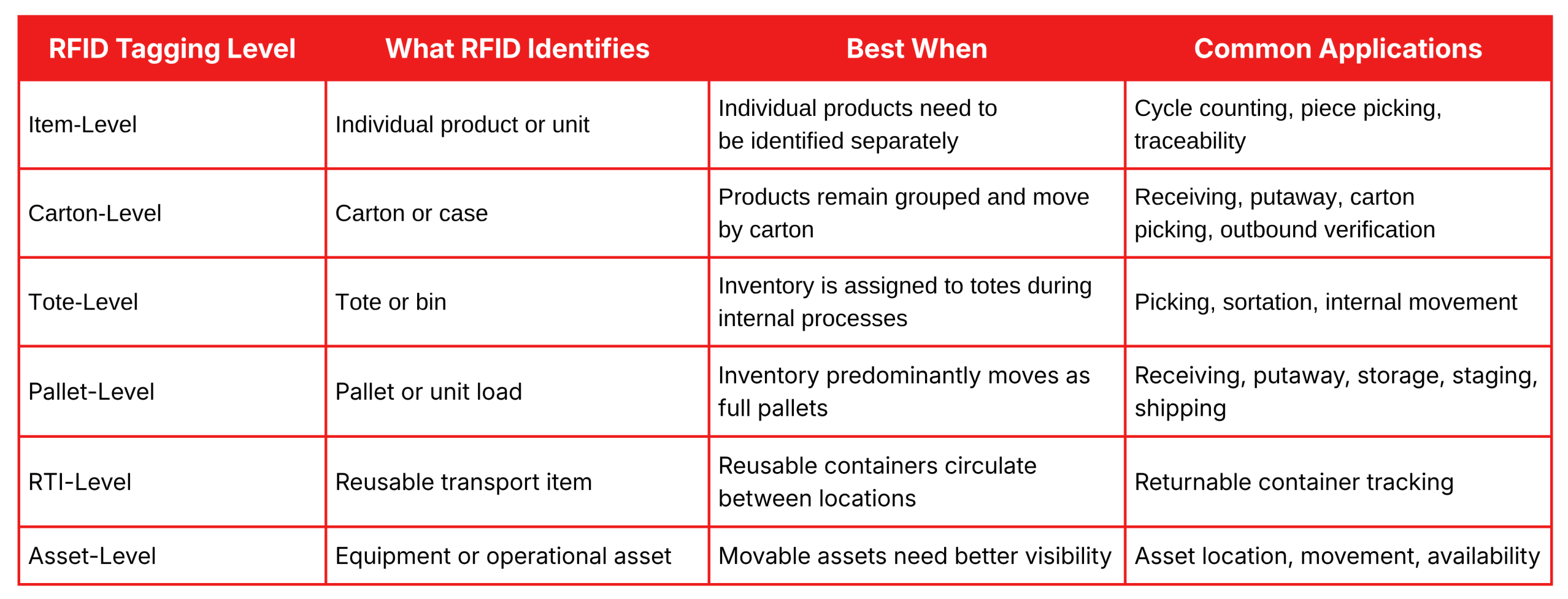
Here is a quick comparison based on RFID-tagging level:
Do You Need to Choose Only One RFID Tagging Level?
No. A warehouse can use multiple RFID tagging levels within the same operation.
For example, a warehouse might use:
- Item-level RFID for high-value products that require individual traceability
- Tote-level RFID to track orders through picking and consolidation
- Pallet-level RFID to automate pallet identification during receiving and shipping
- RTI-level RFID to track reusable containers as they circulate between the warehouse and other locations.
Different levels can also be associated with one another.
For example, RFID-tagged cartons can be assigned to a specific pallet, allowing the system to maintain a relationship between the pallet and the cartons it is expected to carry.
The objective is not to tag everything possible. Instead, select a tagging strategy that provides the right level of visibility to solve the operational problem.
Pro Tip: Start with the 80/20 Principle
Apply the 80/20 principle when deciding where to start.
- Identify the operational problems that create the biggest impact
- Determine which tagging level can address them
- Validate through a Proof of Concept (PoC)
- Once proven, you can gradually expand RFID to other processes or tagging levels as needed.
Test Your RFID Tagging Strategy Before Full Implementation
Once you have selected the appropriate RFID tagging level, the next step is to validate whether it works reliably in your actual warehouse environment.
RFID performance is influenced by more than the tagging level itself.
Before full implementation, test the combination of:
- Product Material
- Tag Type
- Tag Placement
- Read Distance
- Movement
- Reader Position
- Warehouse Environment
For example, products containing metal or liquid can affect RFID readability, while dense pallet configurations may make certain tags more difficult to detect.
Tag orientation, movement speed, nearby tagged inventory, and reader placement can also affect read performance.
That is why a Proof of Concept (PoC) should replicate the actual operational scenario rather than simply test whether an RFID reader can detect a tag.
The goal is to validate that the tagging level, RFID hardware, reading zone, system, and warehouse process work reliably together before scaling the solution.
For a complete framework on implementing RFID, read our Step-by-Step Guide to RFID Migration Without Disrupting Warehouse Operations (Bahasa Indonesia).
Not Sure Where RFID Should Start in Your Warehouse?
If you are still unsure which approach fits your operation, discuss your use case with the Intramega Global team.
Through an initial consultation, you will receive:
- Review of your warehouse condition and challenges that should be prioritized
- Recommendation of RFID tagging level and reading methods for your use case
- Realistic scope for a Proof of Concept (PoC)
The goal is not to implement RFID everywhere, but to start where it can create the most meaningful operational impact and scale from there.
Discuss your RFID case with our team here: +62 811 9121 231